


Cooperatives emerged as associations of ordinary people in response to large-scale capital. In the past, just as today, those who control large amounts of capital have been able to acquire important land and assets in their countries, thereby making ordinary people dependent on their products and services. The process of acquiring all important assets follows the same pattern. Step by step, they begin buying up land, water resources, and businesses until, at some point, they control everything. While making these acquisitions, they initially offer more favorable terms, leading people to believe that things will improve, but later they raise the prices of everything to such a level that ordinary people can barely survive.
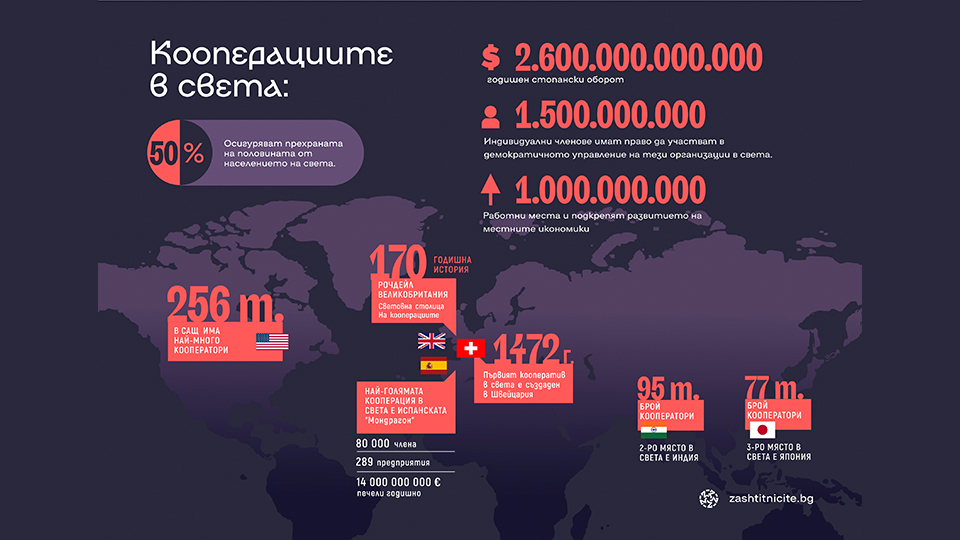
The first cooperative in the world was established in Switzerland in 1472. This was 20 years before the discovery of America. Cooperatives subsequently played a major role in pre-industrial Europe, and wealth began to reach ordinary people rather than remaining solely in the hands of feudal lords. The idea later developed considerably, and today cooperatives around the world have more than 1 billion members, provide employment to 1.5 billion people, and form the basis of the livelihoods of more than 3 billion people.
The figures are striking and help us understand the power of this instrument, which provides ordinary people with an opportunity for fairness and prosperity. The United States has the largest number of cooperative members, with 256 million, followed by India with 95 million and Japan with 77 million cooperative members, while in Europe Italy has the largest number, with 12.6 million. The largest cooperative in the world is Spain's “Mondragon”, which has more than 80,000 members and employees, 289 enterprises in 41 countries, and earns 14 billion annually in 150 countries.
In Bulgaria, cooperatives have lost their popularity because during the 1990s, like everything else inherited from socialism, they were shamelessly plundered, and the people who were members of them suffered losses. This gave cooperatives a bad reputation, and for a period of time this instrument was not used in our country.
At the same time, cooperatives around the world have continued to develop and are the ordinary person's best weapon against being subjected to the control of people who manage an ever-growing percentage of the world's most important assets.
An interesting example is the Mondragon Cooperative Corporation. It was established in 1956 in the Basque town of Mondragon as a combination of the activities of modest technical colleges and a small workshop producing paraffin heaters. It is now the seventh-largest Spanish company by revenue and the leading business group in the Basque Country. At the end of 2008, it employed 92,773 people in 256 companies operating in four areas: finance, industry, retail, and knowledge. The Mondragon cooperatives operate according to a distributive business model based on the supremacy of people and the sovereignty of labor, which has enabled the creation of highly cohesive companies founded on the principle of solidarity and possessing a strong social dimension. The cooperatives are owned by the workers (owners), and authority is based on the principle of “one person, one vote”. The decisive factor in the creation of the cooperatives that now make up the Mondragon Corporation was the arrival in Mondragon in 1941 of the young priest José María Arizmendiarrieta. At the time, the town had a population of 7,000 and was suffering from the painful consequences of the Spanish Civil War: poverty, hunger, neglect, and tension. He decided to do everything in his power to promote mutual assistance and discovered a way to create jobs based on solidarity. With an unusual combination of idealism and pragmatism, in 1943 he founded a technical college open to everyone, which later became an incubator for managers, engineers, and skilled workers for local companies and, above all, for cooperatives.
The ties that unite the cooperatives in Mondragon are strong because they are based on a humanistic concept of business intertwined with a philosophy of participation and solidarity, and a shared business culture founded on a series of fundamental principles: a common mission, acceptance of a set of corporate values, and a common business policy.
Comments
{{itemsCountMessage}}

 Join us


{{parentComent.createdBy.name}}
{{parentComent.date }} {{parentComent.time}}
The comment has been removed due to policy violation
{{parentComent.text}}